Evidence
What it looks like when the data gets cited
Microsoft reports 56.4K citations of REN.PH in 39 days. Google reports 621,552 generative AI impressions in 77 days. The console exports, the per-query citation share, what the answers look like, and what none of it proves.
Published · Updated
- Collected
- Source
- Bing Webmaster Tools AI Performance, 25 June to 2 August 2026, for the citation counts and citation shares. Google Search Console generative AI features, 18 May to 2 August 2026, for the impressions and the page composition. Both exported 5 August 2026. The dataset counts are not from either export: they state their own collection date in the text, and carry their own stamp on About. The engine captures are from June 2026. One is dated to the second from the search timestamp inside its own screenshot, the other three to the month only, and the page says which is which where it shows them.
- Method
- Console exports read as published, and logged-out engine sessions
- Note
- Both consoles describe their own figures as partial. The page says where.
We operate REN.PH, a Philippine real estate data platform holding 234,337 zonal value rows and 25,264 broker records, structured to barangay level across 37,660 barangays. Counted against the operational database on 8 June 2026.
This page is what the engines did with it. It is our own property rather than a client engagement, which is the only reason we can publish the console exports in full instead of describing them.
Citation share, from Microsoft’s own console
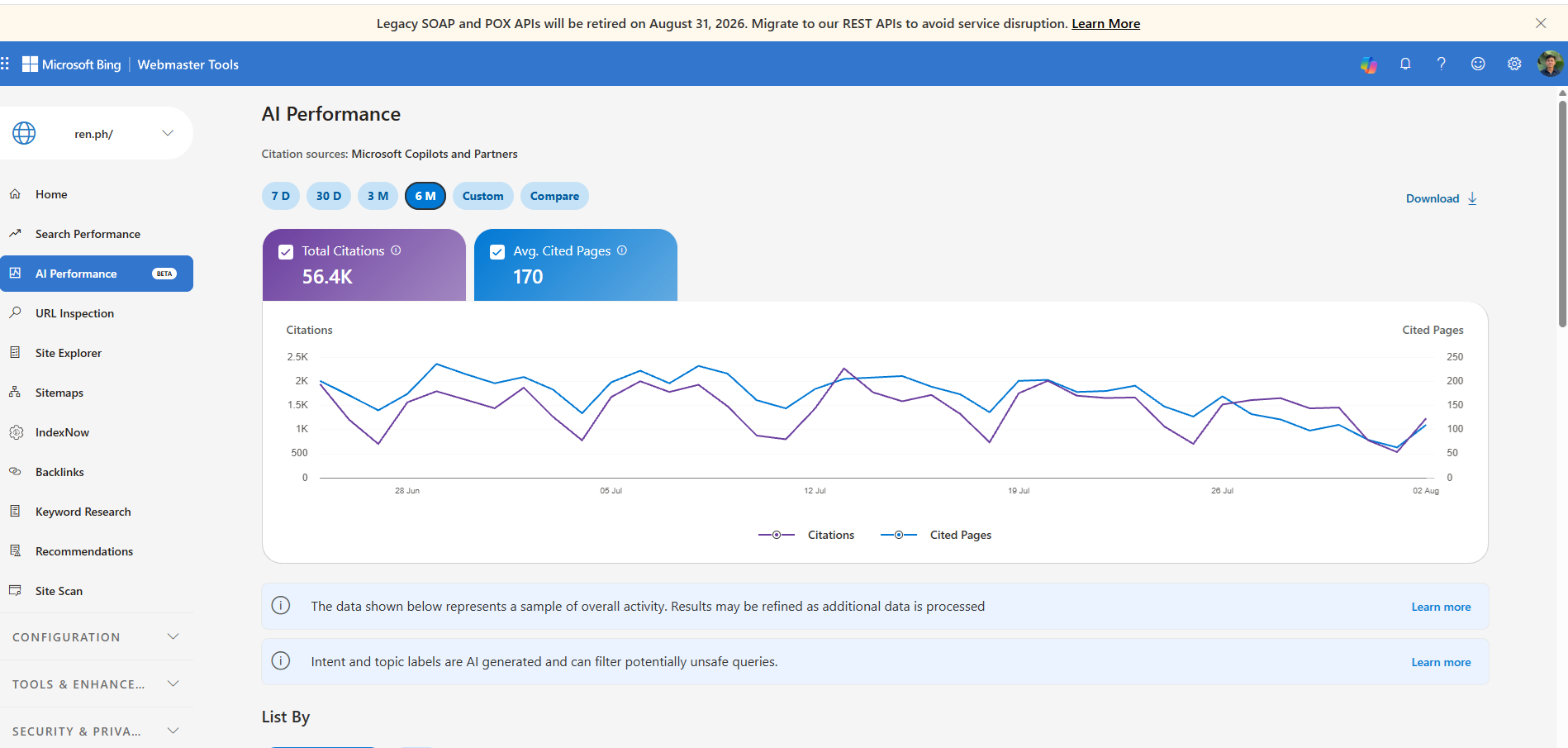
Bing Webmaster Tools reports AI citation data for any site you verify, sourced from Microsoft Copilots and partners. 25 June to 2 August 2026:
| Figure | Value |
|---|---|
| Total citations reported | 56.4K, as the console displays it |
| Average cited pages | 170 |
| Days in the window | 39 |
| Grounding queries in the export | 124 |
| Citations across those 124 queries | 28,233 |
| Median citation share across them | 26.3% |
| Queries above 30% share | 47 |
Three things in that table need saying before anyone quotes it.
The headline is rounded and the export is not. Bing prints 56.4K, which is anywhere from 56,350 to 56,449, and it is the only form of that figure the interface gives. The 28,233 is a sum of exported rows and is exact. We are not going to turn the first into 56,400 so the pair looks like arithmetic.
The 124 queries do not add up to the total. They add up to 28,233, which is close to half of the 56.4K the console reports, and the rounding above is why that is “close to half” rather than a figure to a decimal place. The rest is a tail Bing does not export. So the median and the share figures describe about half the citations, and the other half is a number we can see the size of and nothing else.
The window is 39 days, not six months. The screenshot has the 6-month view selected and returns the same figure, because 25 June is when the property was connected to Bing Webmaster Tools. There is no earlier data to show.
Microsoft’s own caveat, stated because it belongs here: the data shown represents a sample of overall activity and results may be refined as more is processed.
Per query, on the five highest-volume terms
| Grounding query | Citations | Citation share |
|---|---|---|
| zonal value bir 2026 | 7,164 | 33.1% |
| bir zonal value 2026 | 6,190 | 34.7% |
| bir zonal value | 3,944 | 38.3% |
| zonal value | 1,949 | 27.8% |
| 4ph program pag ibig | 1,366 | 6.4% |
The fifth row is there because it is the fifth row. On the query with the fifth-highest citation count in the export, REN.PH holds 6.4% share and is a minor source. It is a housing programme question rather than a valuation question, and the dataset has nothing specific to say about it.
Citation share across the 124 queries ranges from 5.6% to 64.7%. Each of those is Bing’s figure for a query, not a run of ours: nothing on this page is the 5-engine, 3-run method we sell, and “run” means something specific there. The highest figures sit on the smallest queries: 64.7% is 11 citations on “zonal value san pablo city per sq mt”. Read the 38.3% on “bir zonal value” as the meaningful one, because 3,944 citations is a number that survives a slow week.
The top 5 queries account for 73% of the exported citations. This is a concentrated result on one topic, not broad coverage.
This is the citation half, measured by the engine rather than by us. Recommendation share is what our higher retainer tier contracts on, and Bing does not report it. Nothing on this page shows whether a model named REN.PH as a vendor to consider, because a data platform is not what a buyer asks a model to recommend. Citation share is the metric that fits this property, and it is the narrower of the two.
Generative AI impressions, from Google
Google Search Console’s Generative AI features report, 18 May to 2 August 2026, 77 days: 621,552 impressions.
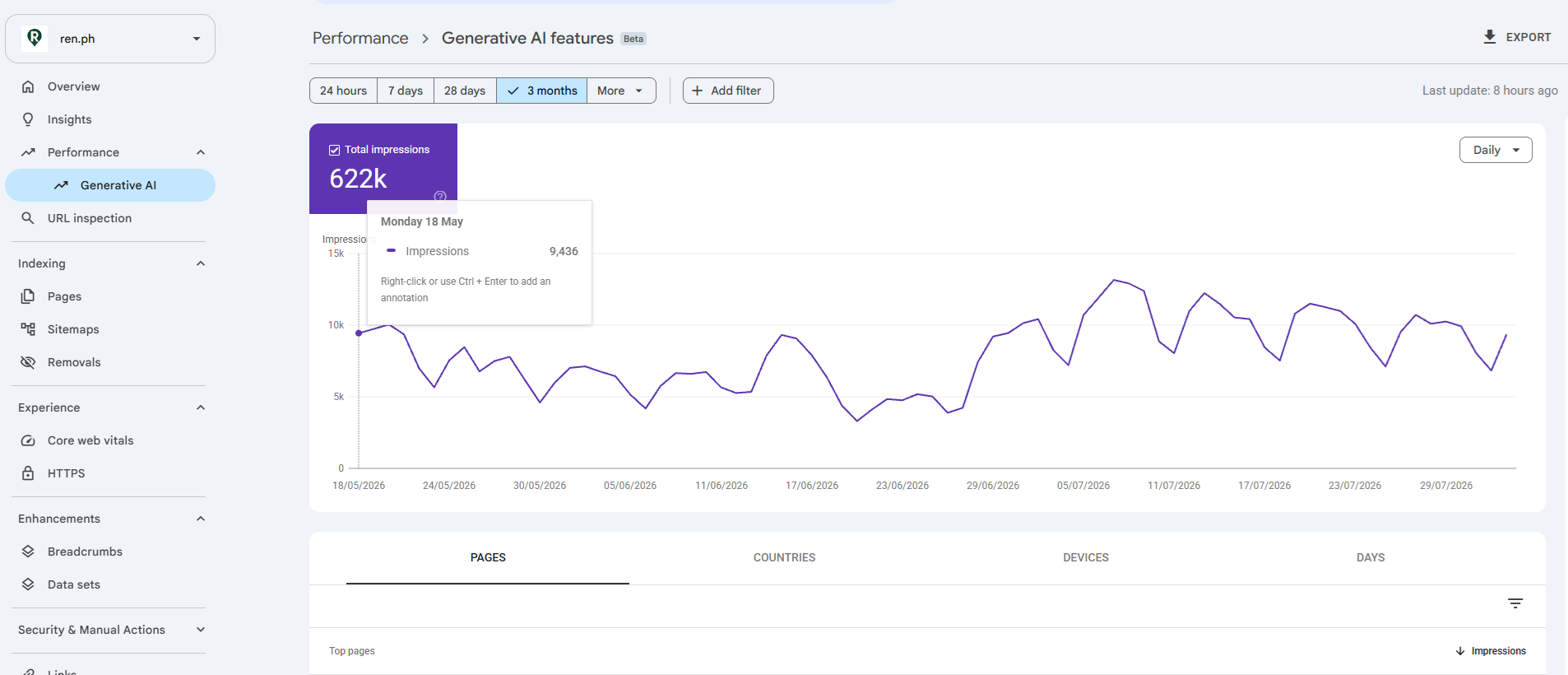
The report is in beta and Google labels it so in the interface.
The screenshot has the 3-month filter selected and the chart still begins on 18 May. Three months back would reach early May, so 18 May is where Google’s data starts rather than a range we chose. The 6-month view returns the same series.
Of those impressions, 557,826 are from the Philippines, which is 89.7%. This is a Philippine audience, including Filipinos abroad researching property at home. Nothing here is a claim about reach into any other market.
What gets cited is the page that owns one answer
The composition of those impressions is the most useful finding on this page for anyone deciding what to publish.
Google exports the top 1,000 pages, which carry 419,875 impressions, or 67.6% of the total. Within that:
| Section | Impressions | Share of the export |
|---|---|---|
| /tools/ | 304,377 | 72.5% |
| /academy/ | 88,841 | 21.2% |
| /guides/ | 10,916 | 2.6% |
| Page | Impressions |
|---|---|
| /tools/zonal-value | 30,199 |
| /tools/transfer-tax-calculator | 26,739 |
| /tools/pagibig-housing-loan-calculator | 21,675 |
| /academy/courses/real-estate-math-essentials/commission-calculations | 11,823 |
| /academy/courses/rent-control-essentials/deposits-and-advance-rent | 10,251 |
| /guides/how-to-transfer-property-title-philippines | 5,802 |
| /guides/how-to-compute-property-value-philippines | 3,857 |
The easy read is that tools get cited and writing does not. That is not what the export says, and we drafted this page with that claim in it before checking.
The second-largest section is course lessons, which are written prose, and they pull 8 times what the guides pull. Commission calculations. Deposits and advance rent. Lot area and pricing. Every one of them is an article that owns one specific procedure and answers it with a number.
The guides are also articles. They discuss a topic across several thousand words and they sit at 2.6%.
So the split is not calculators against writing. It is pages that own one specific answer against pages that cover a subject. A calculator is the purest form of the first kind, which is why the tools lead, and a lesson on how a commission is computed is the same shape in prose.
What the answers actually look like
Captures from June 2026, logged-out sessions, one run each. We recorded the month and not the day. One of the four dates itself and three do not, which is the gap: the rest of this page dates everything to a day because we can. Anything captured since carries a date, and these three are not re-datable after the fact.
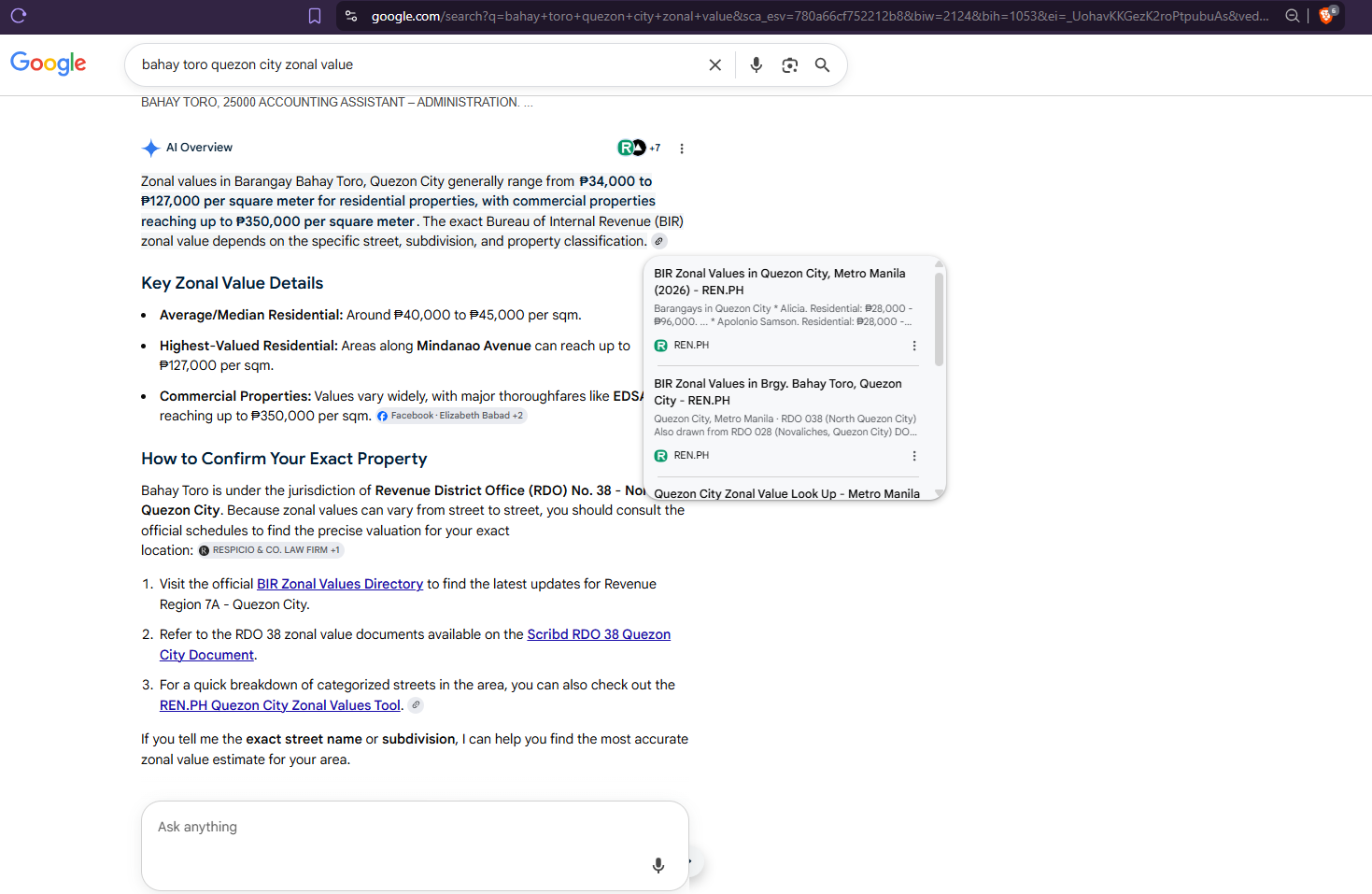
Google AI Overview, Bahay Toro, Quezon City. 4 June 2026, 09:53 UTC. Two REN.PH pages are the first two sources in the panel, for the headline barangay range. A Facebook post, a law firm page and a Scribd document appear against smaller fragments of the answer.
The timestamp is not something we wrote down. It is inside the screenshot. Every
Google results URL carries an ei parameter, and the first four bytes of that
value, base64url decoded and read as a little-endian integer, are the Unix time
the search ran. The address bar is legible in the capture below, so you can
decode it yourself rather than take the date from us. The other three captures
are on engines whose URLs carry no time: Perplexity’s is a random UUID, and
both ChatGPT ones are the bare domain.
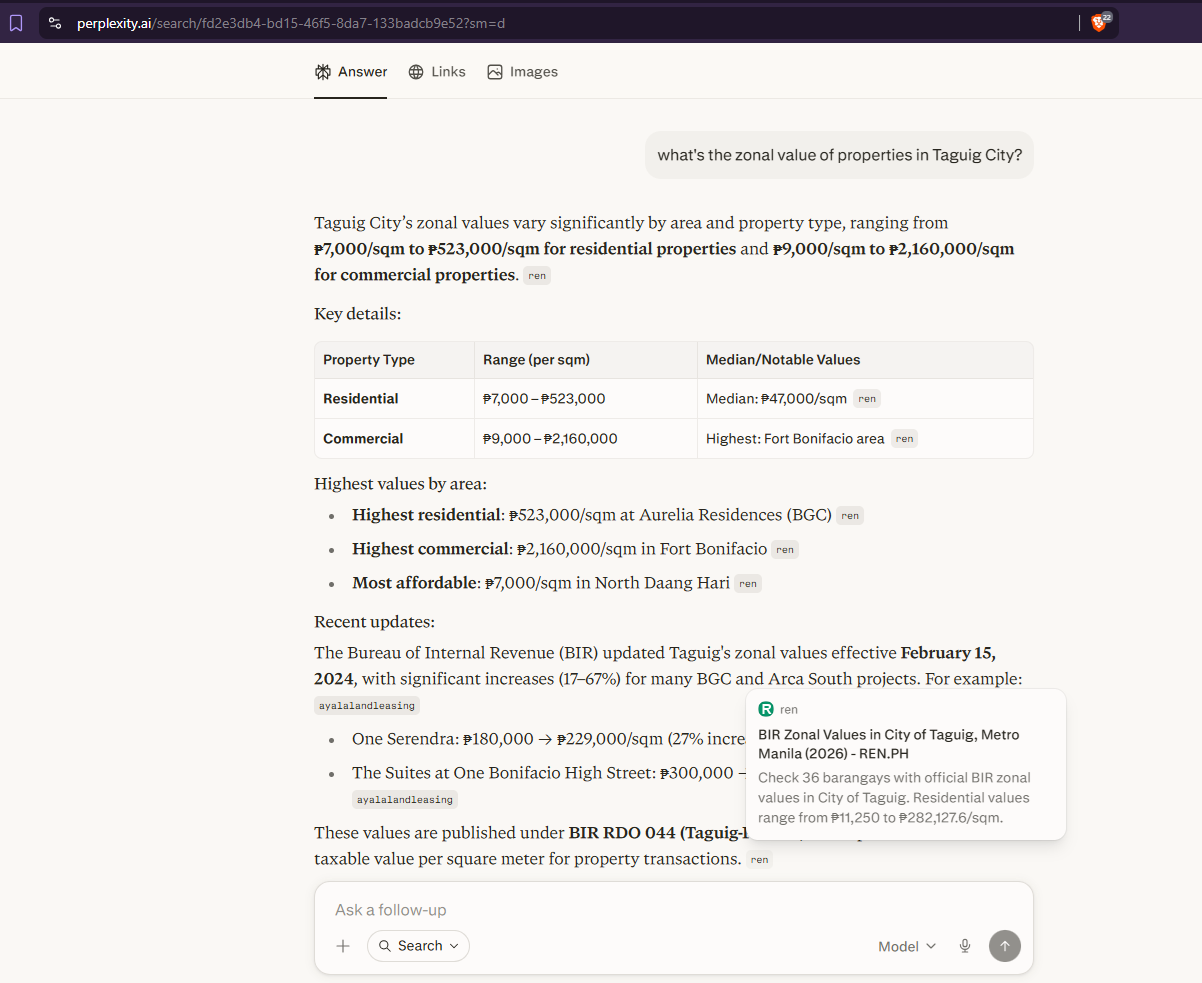
Perplexity, Taguig City. REN.PH is cited 7 times in a single answer, including on the median, on the highest and lowest values, and on the closing statement about which BIR district publishes them.
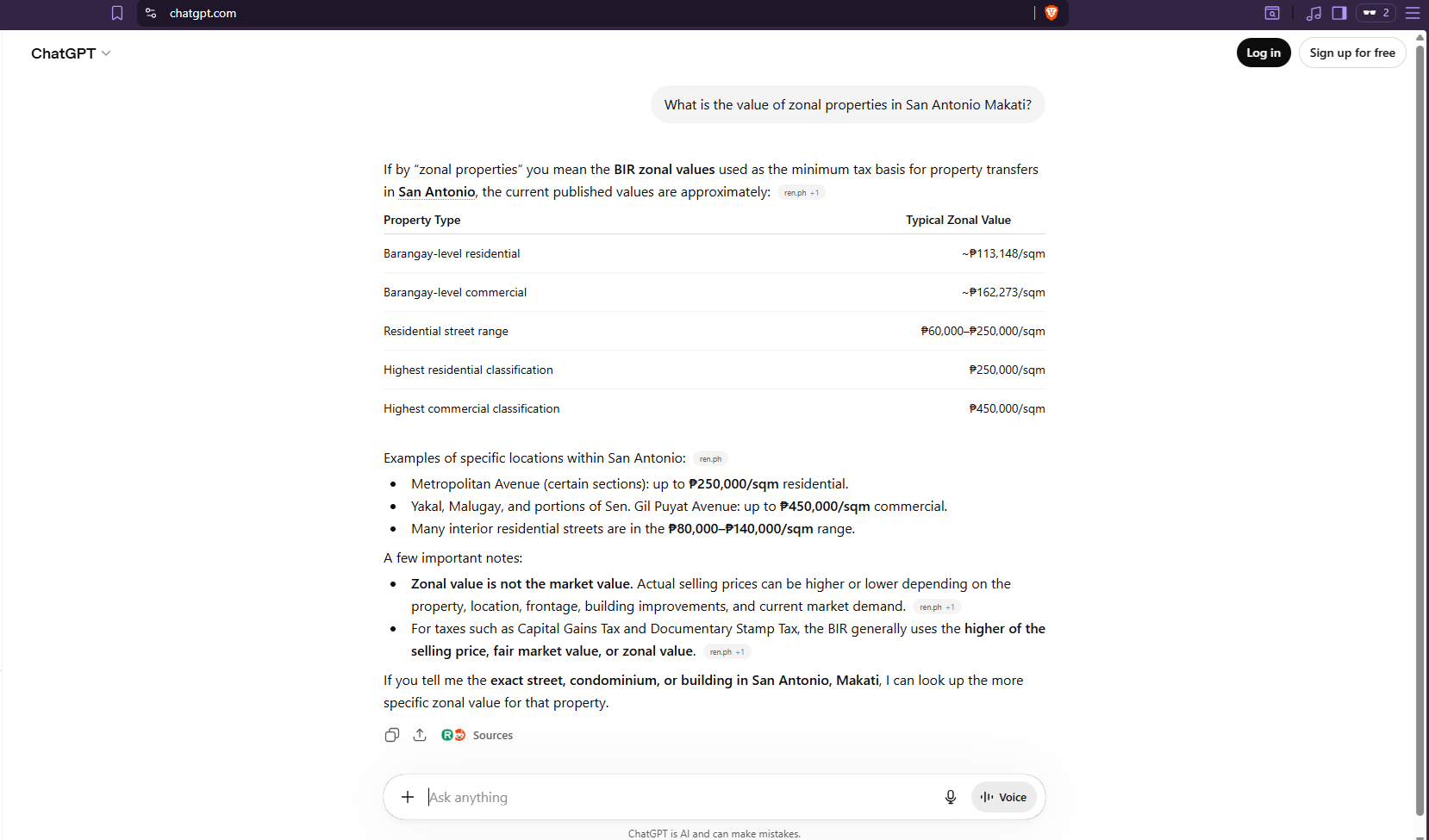
ChatGPT, San Antonio, Makati. Every citation in the answer leads with REN.PH, across a barangay-level value table and a list of street-level examples.
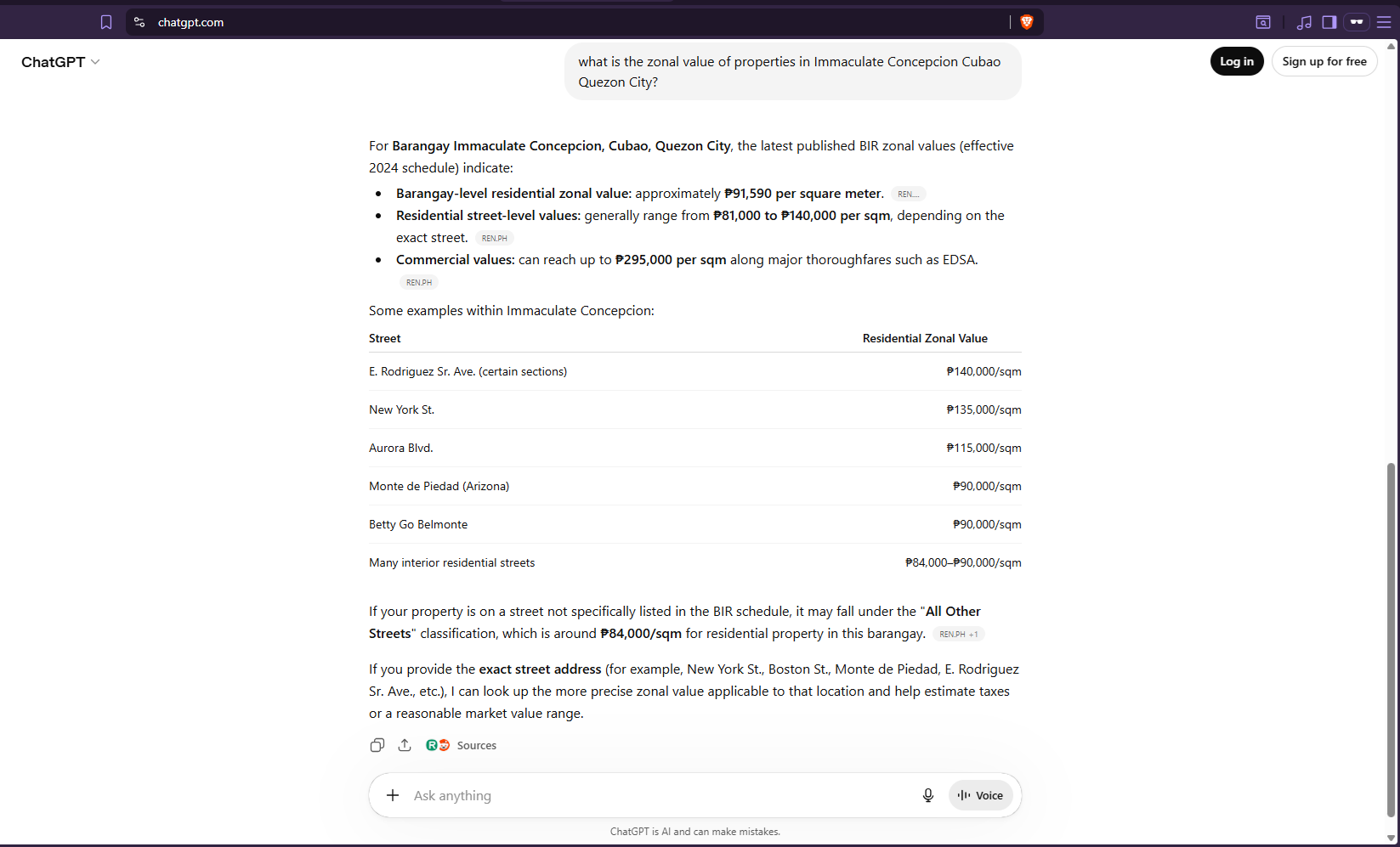
ChatGPT, Immaculate Concepcion, Quezon City. The answer grounds a street-level table down to individual roads: E. Rodriguez Sr. Ave. at ₱140,000 per sqm, New York St. at ₱135,000, Aurora Blvd. at ₱115,000, and three more. The citations sit on the statements around the table rather than inside its rows.
On city-level head terms the answers are contested and REN.PH appears alongside other sources. The further a question drills down, the more often it is the only source cited, because most competitors stop at the city level.
Why the engines cite it
An engine rewrites a question into smaller ones, retrieves passage-sized chunks to answer each, and attaches a citation claim by claim. A page wins that citation when it is the lowest-risk way to ground a specific claim.
Each figure on REN.PH is specific, traced to a government geographic code and the tax department order it came from, current, and published on its own page. When someone asks for the value of a particular barangay, the engine does not assemble an answer from fragments. A source owns the claim, so it cites it.
The opposite case is what happens when no page owns the answer. Engines still return a confident number, and the page cited for it sometimes does not contain that figure at all.
How it was built
Five stages, each handing off to the next. Architect, research, normalizer, validator, publisher.
The validator is the one that decides everything downstream. Every value is cross-checked against its source record and tied to the geographic code and the government order it came from. That grounding is why the data is citable. An engine can trace a figure back to an official document, which is the signal it needs to cite a source rather than generate one.
The automation was never the point. The point was that every figure had to be defensible against its source before it went live.
What produced the result, and what did not
REN.PH has no advertising spend in any market. It has no link-building campaign behind it. It is not a recognised brand outside the Philippines, and the queries it wins are not brand queries.
What it has is 234,337 rows of specific data, each one traceable to the document it came from, each one on a page that owns its claim.
That combination is the whole explanation, and it is the part that transfers. If you are competing against an incumbent with twenty years of domain history and a budget you cannot match, owning the specific number is a different game from outspending them.
What transfers to a proptech company
The data types are the same object class. Zonal values, broker records and transaction history are structurally the same as rent comps, cap rates, absorption and cost benchmarks. Specific, sourced, and the thing a buyer asks for by name.
Most proptech and CRE software companies already hold that data. It sits inside the product, behind a login, where no model can reach it. Their marketing publishes trend commentary and competes with every other company publishing trend commentary.
The work is the same as the work above. One page per entity, every figure traceable to its source, provenance visible rather than asserted. Then measure whether the engines start citing it.
That measurement is free, on your own site, today. Bing Webmaster Tools reports AI citations and citation share. Google Search Console reports generative AI impressions. Most companies have switched on neither.
What this does not show
We have not tested all 37,660 barangays. Four captures are four samples, and citation results vary by engine, by phrasing and by run.
AI answers are non-deterministic. Your result on the same query may differ from ours. We measure citation frequency over time rather than treating a single capture as an outcome.
Both console exports are partial and we have said where. Bing exports 124 queries covering half the citations it reports. Google exports 1,000 pages covering two thirds of its impressions. The sections below those thresholds are not described here because we cannot see them.
Neither console reports what share of the answer we won, only that we were cited. A citation on a fragment counts the same as a citation on the headline figure, and the captures above are the only place on this page you can see the difference.
On city-level queries the answers are contested and REN.PH is one source among several. The pattern holds below the city level, which is where the data is more specific than anyone else’s.
Google’s generative AI report is beta. Counts are operational database coverage and shift as records are re-grounded.
This is one property in one country on one topic, run by the firm publishing the page about it. It is a mechanism with numbers attached, not a result we have reproduced for anybody else yet.